






· 8 min read
For half a century before the first motor truck rolled into McLaren Vale, a horse-drawn tramway ran from the vineyards down to the jetty at Port Willunga. Locals called it the Tin Pot. Its cuttings, sleepers and earthworks are still in the ground under what is now the Coast to Vines Rail Trail.
The problem of getting the harvest out
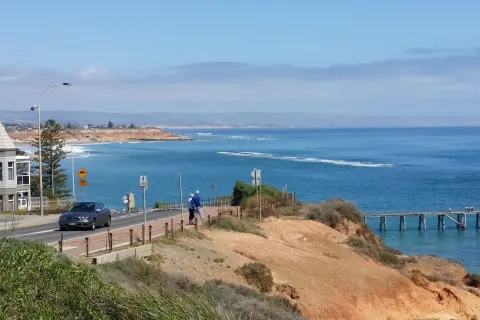
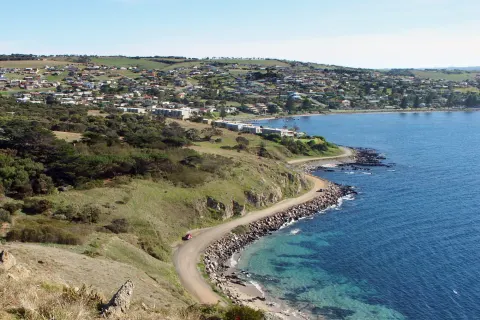
In the 1850s and 1860s, McLaren Vale was a cluster of farms on a slope above a gulf with no usable port. The vines and almonds and grain that came out of the district every autumn had to be hauled somewhere a ship could load them, and the only ships on this stretch of the Gulf St Vincent coast were the ketches and small steamers that anchored offshore from Port Willunga Beach and loaded over a long timber jetty. The jetty had been built in 1853 after the original 1850 open-roadstead loading method proved unworkable in winter. It stuck out into the gulf from the cliff at Port Willunga on the same line where the pylons still stand in the surf today.
The difficulty was getting the harvest from the Vale down to the jetty. The direct distance is only about seven kilometres but the country is broken by the Willunga Scarp and a series of creek gullies that had no proper road. Bullock drays could do the trip in dry weather. In winter the track between the Vale and Port Willunga was essentially impassable for a loaded wagon. For a district whose entire economy depended on getting the harvest to ship before the weather turned, this was a crisis that repeated itself every year.
The solution the district settled on in the late 1850s was a tramway.
Building the Tin Pot
The line that was eventually built was never a proper railway in the modern sense. It was a horse-drawn tramway on timber rails, later on light iron rails, built with private money by the farming families of the Vale and operated cooperatively. Construction began in 1857. By 1860 the line ran from near the modern Hardys Tintara winery site, south-west across the flats, over the Willunga Creek, down the cutting below what is now Aldinga Road, and onto the beach reserve at Port Willunga.
Locals called it the Tin Pot Tramway almost from the beginning, and nobody seems to remember exactly why. One story has it that the first trucks used on the line were built with flattened kerosene-tin cladding. Another has it that the tin kettles the drovers carried on the wagons rattled audibly from half a kilometre away. Whichever is true, the name stuck. Through the 1860s and 1870s the Tin Pot was simply what the Vale called its way out to the sea.
The wagons were flat-decked timber trucks, pulled by a single draft horse or a pair depending on the load. A loaded wagon could carry roughly a tonne. The round trip from the Vale to the jetty and back took most of a working day. In harvest season there were wagons running from first light, carrying barrels of fortified wine from the early darenberg and Hardys operations, sacks of almonds from the orchards east of willunga, wheat from the farms on the flat, and fruit from the orchards on the slope. The cargo went onto the ketches at the jetty and sailed the short hop up the gulf to Port Adelaide.
What the tramway carried
The Tin Pot was not primarily a wine tramway in the modern sense. In the 1860s and 1870s the dominant McLaren Vale crops were almonds, wheat and grazing. The wine trade was still small - Hardys Tintara had been producing commercially since 1858, but the big volumes were fortified wine sold in bulk, and the barrels were heavy awkward cargo for a horse-drawn tram. Most of the tonnage on the line was almond sacks, wheat and hay.
By the 1880s the balance started to shift. The fortified wine trade to Britain was growing. The McLaren Vale wineries were producing more port, sherry and muscat in bigger barrels, and those barrels needed the tramway to reach the jetty. For a decade or so in the 1880s and early 1890s, the Tin Pot was a wine line in a way it had never been before - and it was at exactly this moment that the jetty was extended and improved to handle the heavier loads.
The line also carried slate. The Willunga slate quarries, worked by Cornish miners from the 1840s onward, sent some of their product out via the Tin Pot to the Port Willunga jetty and from there to Adelaide. You can still see the slate-loading platforms at the Willunga Slate Museum, and the road that runs past the museum traces roughly the old feeder line from the quarries that joined the main tramway near central Willunga.
The end of the line
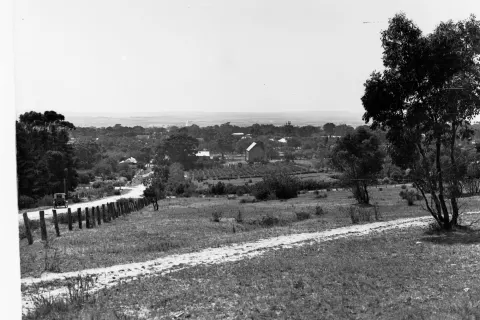
What killed the Tin Pot was the railway - the real railway. In 1915 the South Australian Railways extended the government Willunga branch line from Adelaide as far as Willunga. A proper steam railway, with proper government iron rails, running to a proper Adelaide terminus, did the job the horse tramway had been doing for fifty years, only faster and cheaper. Within a year of the Willunga railway opening, the Tin Pot had lost most of its traffic. By 1920 it was effectively disused. The rails were lifted during the 1920s for scrap. The wagons were sold or broken up. The horses went back to farm work. Nobody wrote a formal obituary and very few photographs of the tramway in operation survive.
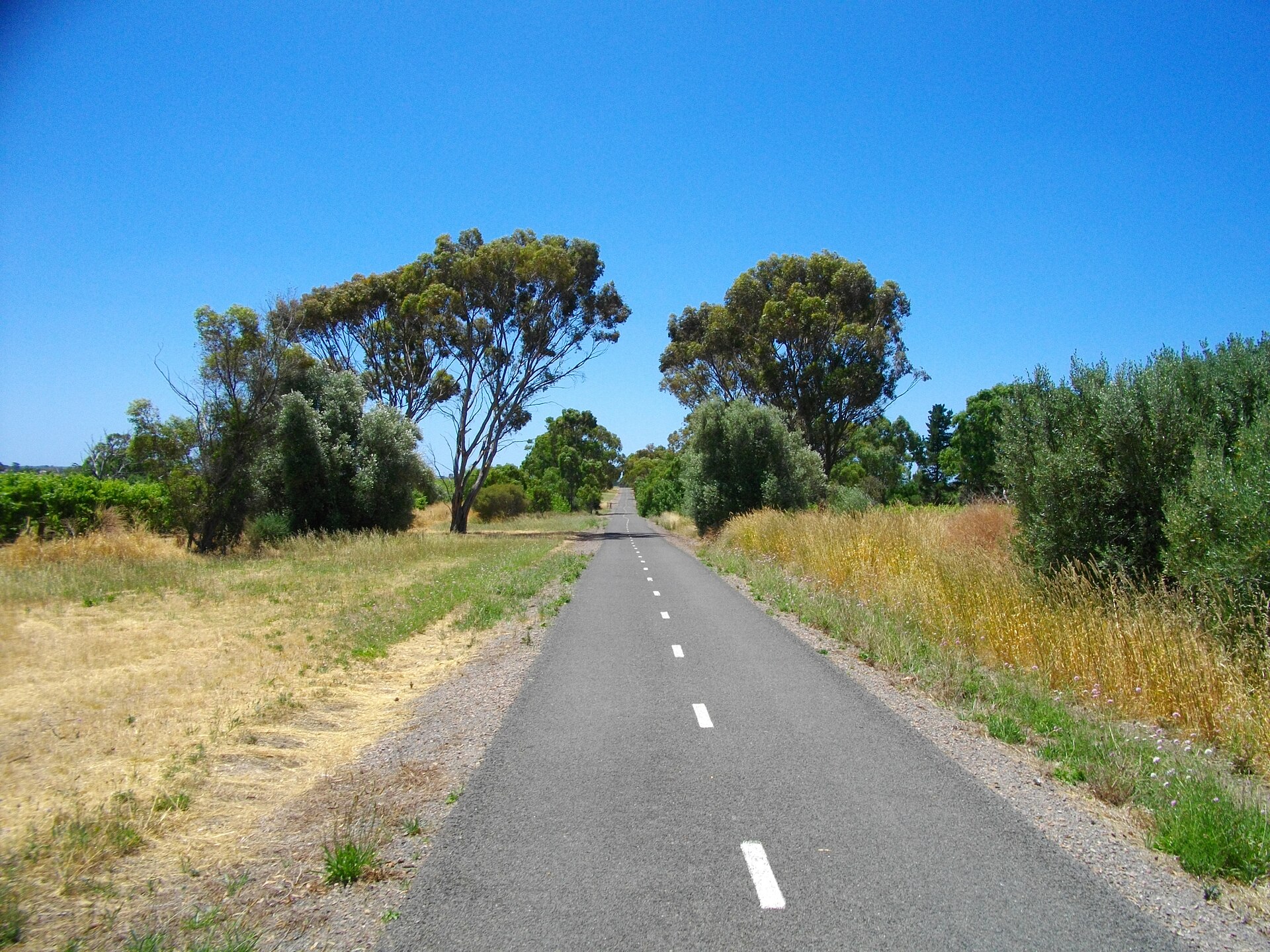
The Willunga branch line itself lasted another fifty years, carrying commuters and harvest produce up to Adelaide, before it too closed in 1969. Its corridor was rebuilt in the 1990s and 2000s as a sealed bicycle path - the Coast to Vines Rail Trail that now runs the length of the Vale.
What you can still see
The earthworks of the Tin Pot are still in the ground, and if you know where to look you can trace long sections of the original route.
The easiest surviving stretch is the cutting below Aldinga Road, roughly two kilometres inland from Port Willunga Beach. From the beach reserve carpark, walk up the old jetty road and then east along the cliff-top path. Within a few hundred metres you will pick up a flat bench cut into the slope - grassed over, gently graded, about three metres wide. That is the old tramway formation. It runs east for several hundred metres before disappearing into private land.
A second section is visible near the modern rail trail where it crosses Aldinga Road. The tramway and the later railway did not follow identical routes - the 1915 railway took a straighter line up the slope - but they converged in places, and the tramway formation runs parallel to the sealed cycle path for about 400 metres south of the Aldinga Road crossing. Look for the slightly lower, softer track on the western side. That is the Tin Pot.
The best surviving artefact is at the Willunga Courthouse Museum in the village. The museum holds several of the original timber sleepers salvaged when the line was lifted, along with one of the wagon axle assemblies, a set of horse-harness fittings, and a single 1860s invoice from a Vale grower for one tonne of wine shipped via the tramway to the Port Willunga jetty. The museum is open on weekend afternoons and is run by local volunteers who know the tramway story better than anyone.
The Willunga Slate Museum on High Street has the slate side of the story - photographs of the quarry feeder line, a short interpretive panel, and one of the original slate trolleys.
A short walk along the old line
The most satisfying way to feel the Tin Pot is to walk a section of the Coast to Vines Rail Trail from central willunga south-west toward Port Willunga Beach. It is about five kilometres, mostly downhill, graded for cyclists and walkers. Every few hundred metres you will see the older tramway formation diverging slightly from the sealed path - a lower bench, a different line of mature eucalypts, a subtle change in the vegetation where the fill was laid a century and a half ago. The walk ends on the beach, where the jetty pylons are still in the surf and the whole point of the Tin Pot - getting the Vale's harvest to a ship - is still physically visible.
The Alma Hotel on High Street in Willunga, across the road from the Willunga Farmers Market site, is the natural finish. It was there when the tramway was running and it is still there now.